Sunkye’s parts offer from laboratory validation to mission critical reliability 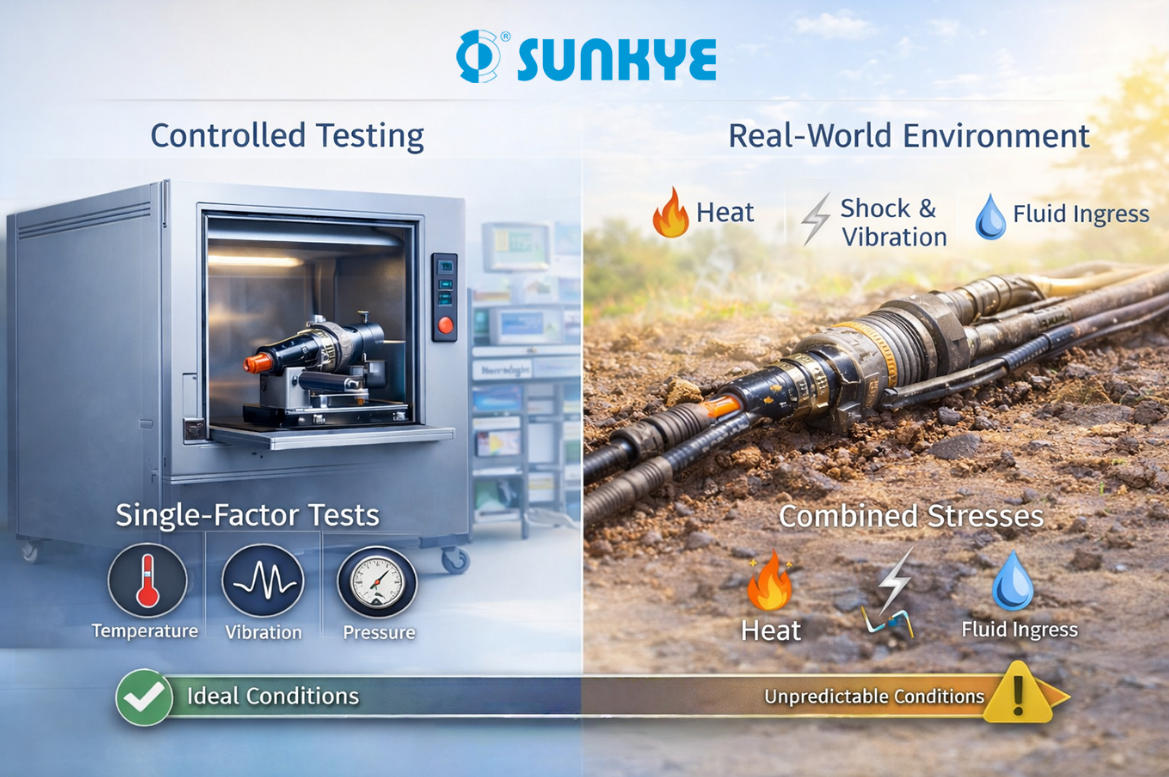
Engineers rely on laboratory test data because it provides controlled, repeatable measurements. Purchase teams rely on it because it offers objective evidence of compliance. However, in many industries, from oil & gas to aerospace, defense, and industrial automation field failures still occur after products have passed all required tests. The problem is not that testing is wrong, but that testing is a model, and every model simplifies reality.
First, laboratory tests isolate variables, and the real environments combine them. In a lab, temperature, vibration, pressure, humidity, and chemical exposure are typically evaluated as individual or lightly coupled conditions. In the real applications, these factors act simultaneously. Elevated temperature accelerates material aging. Vibration promotes fretting and micro-movement. Pressure drives fluids through microscopic voids. Corrosive agents change contact resistance and surface chemistry. These effects amplify each other in ways that are difficult to predict from single-factor qualification tests.
This is why at Sunkye’s Lab, environmental testing is designed to be multi-stress based, not single-parameter. High-temperature, high-pressure, vibration, and electrical loading can be applied together to better replicate how interconnects behave in actual service environments rather than in idealized test chambers.
Second, boundary conditions in the field are never ideal. Laboratory fixtures ensure perfect alignment, controlled mating force, and strain-free cable routing. In real assemblies, tolerances stack up. Cables are bent, twisted, and routed through tight spaces. Operators apply inconsistent torque. Connectors may be mated under side-load or vibration. These small deviations shift stress into sealing interfaces and contact springs, accelerating wear and leakage pathways.
To address this, Sunkye’s Lab validates not just components, but assemblies, including cable terminations, feedthroughs, and sealing interfaces which are under realistic mechanical constraints. This helps reveal failure modes that simple plug-and-test methods miss.
Third, time is a critical but underestimated variable. Many degradation mechanisms are slow: seal compression set, polymer creep, galvanic corrosion, insulation embrittlement, and contact fretting. A connector that passes a 48-hour test may still fail after months of thermal cycling or pressure exposure. Qualification proves short-term robustness, long-term reliability requires aging, cycling, and endurance testing.
Sunkye’s Lab in testing long duration pressure and temperature cycling and electrical monitoring allow these time dependent effects to be observed before products ever reach the field. To reduce the risk of unexpected field failures, qualification testing must replicate the environmental conditions and duty cycles that connectors will experience throughout their service life.
Finally, connectors exist within systems, not in isolation. Signal integrity, grounding, shielding, cable construction, and feedthroughs interface all influence performance. A connector that looks compliant on paper can become the weakest link when integrated into a complex system.
Bridging the gap between testing and real use means shifting from “Did it pass the standard?” to “Does it survive the mission?” That is where realistic, system level validation makes the difference between theoretical compliance and true reliability.

 English
  日本語
日本語  한국어
한국어  français
  Deutsch
  Español
  italiano
  русский
  Türkçe
  Svenska
  Nederland
  فارسی
فارسی فارسی
فارسی